Thursday, March 26, 2009

中国外储难言之隐:不得不承认美国债比黄金更可靠

浏星雨

不久前,还在幸灾乐祸地隔山观火(美国次贷危机),不到半年这"火"就烧到咱家柴棚来了。不久前,还在自豪地津津乐道于中国外汇储备世界第一,转而就发觉这世界第一的外汇储备原来是个烫手的"山芋",让各界人士为之寝食难安。

美国次贷危机爆发后,在爱国经济学家仲大军,宋鸿兵们"大抛美国国债"的呼叫声中,美国国债却是越买越多,月购数百亿,赶超日本,也成了世界第一,达6800亿之巨。

如果做个民意调查,我敢肯定99&的中国人都会选择"反对"。一些人会认为美国国债是被硬性摊派或认购的,是被绑架了;一些人会认为购买美国国债是花钱消灾,为中国和平建设购买时间;一些人会认为买美国国债是用中国人民的血汗支援美国建设,替美国消费买单;还有少数人会认为把外汇用于购买美国国债是为了外逃的时候方便,是里通外国的卖国行为。

这些实际上主要是误解的结果。国际金融在中国长期被神秘化,导致大多数人搞不懂一些基本的金融概念,闹不清一些正常的金融现象。大多数中国人并不了解中国外汇储备的来源和目的,也不知道国债和股票的区别。(具体请参见笔者文章《深入浅出地解读中国持续增持美国国债的行为》和《与爱国学者谈美元外汇储备》)

昨天,中国银监会罗平主任在美国纽约华尔街发表演讲后表示:"尽管知道美元将贬值,但中国将继续购买美国国债"。因为资金的安全避难所是美国债券,而不是黄金,更不是日本政府债券或英国债券。罗平主任用英语反问:"Except for US Treasuries, what can you hold?" he asked. "Gold? You don't hold Japanese government bonds or UK bonds. US Treasuries are the safe haven. For everyone, including China, it is the only option.";"We hate you guys. Once you start issuing $1 trillion-$2 trillion [$1,000bn-$2,000bn] . . .we know the dollar is going to depreciate, so we hate you guys but there is nothing much we can do."

此言一出,立即在各大新闻论坛引起巨大反响。笔者看了一下搜狐和网易的评论留言,绝大多数人情绪激动,"","买办","卖国贼"不绝于耳。

其实,罗平主任的讲话是符合温-家-宝-总-理上月底对驻英中资金融机构的相关讲话精神的。温-总-理说:购买美国债券是中国实行外汇储备多元化的一个重要部分。"是否会继续买、买多少,那要根据中国的需要,根据外汇安全、保值的要求"。温-总-理还提醒大家,中国的外汇储备是人民银行用(印刷的)人民币买下来的,是中国央行的负债(而不是资产)。

温-总-理很明确地说了美国债券"是否会继续买、买多少,那要根据中国的需要,根据外汇安全、保值的要求",而不是根据美国或世界别的国家的要求而定。

自从新中国成立以来,外汇一直是由总理亲自掌握的,大笔动用或调拨投资必须经过政治局讨论决议。当年是周-总-理,后来是X总理,朱-总理,现在是温-总理。这届政府,被称为亲民政府。胡-温当然是维护中国国家和民族利益的,也是体察民情,重视网络舆论的。那么为什么国家的实际动作频频逆"流"而动呢?

其实,这里有难言之隐:

首先,中国的外汇储备是"鲸吞"来的。中国的外汇体制和日本,欧美国家不同。中国现行外汇制度决定了中国政府必须无限制地,被动地印刷人民币纸钞用以收购美元等外汇,以维持人民币汇率的稳定。结果就是,只要人民银行的"柜台"前出现了美元等外汇,人民银行就发行人民币加以收购。买入的美元等外汇则构成了中国的外汇储备。

维持人民币币值和汇率的稳定是中国外汇储备的首要任务。而要担当这个首要任务,外汇储备的形式就必须符合"安全性,流动性和保值性"这三个基本要求。安全性排第一,流动性排第二,保值或增值性排最后。这就决定了中国政府不能将大部分外汇储备用于购买黄金,石油和矿产等实物。(当然可以适当购买,详细参见笔者的《深入浅出地解读中国持续增持美国国债的行为》和《美元是美金,黄金是废铁》)

第二,中国的2万亿外汇储备中的大多数不是属于我们中国人自己的财产,而是属于外国政府和外国老板的。中国外汇储备含有外国商人来华投资的款项,含有中国所积欠的外债,还有大家熟知的"热钱"(国际游资),当然还有贸易顺差。但是,即使在贸易顺差中,也并不是全部是我们中国人自己的,而是有很一大部分属于跨国企业的资产。为了维护中国国家信誉,为了维持正常的经济秩序,就必须满足外商和内商的经常性兑换需求。这就决定了中国政府不能将大部分外汇储备用于购买黄金,石油和矿产等实物。(当然可以适当购买,详细参见笔者的《中国和日本外汇储备的巨大不同》和《虚胖的中国外汇储备》)

根据国家统计局公布的2007年年末的《中国国际投资头寸表》,在2007年,中国政府拥有1.5282万亿美元外汇储备,同时外国在华资产为1.2664万美元。可见真正属于中国人自己的外汇储备份额大约在3000多亿美元,只占中国外汇储备总额的25-30%。而且在2007年年底,中国的海外资产总额只有1.0126万亿美元,比外国在华资产少2448亿美元。也就是说,假如外国资本要求全部撤出中国的话,在没有充足的外汇储备的情况下,卖掉全部的中国在海外的资产也不足于应付。这就是中国要维持庞大的外汇储备的一个重要原因。否则几个索罗斯那样的对冲基金就可能让中国金融阵脚大乱(参见笔者的《中国是债权国还是债务国》一文)

好了,从上述分析中,第一,我们已经知道中国为什么会有庞大的外汇储备;第二,我们已经知道中国为什么必须维持庞大的外汇储备。那么,在这样的现实前提下,如何保管好这巨大的外汇储备就成了一个大问题。

中国本土企业和外资企业的经济活动经常性地需要美元;外国政府和外国银行的贷款每月都有到期的;"热钱"是随时要溜出中国的。这就要求中国政府手里必须有足够的流动性外汇来应付这些日常所需。流动性最高的当属现金了,"现金为王"大致就是这个意思。

那为什么不存银行的定期,而要买美国国债呢?这有两方面的原因:其一,美国国债容量大(可供买卖的共有6.3万亿美元),需求强劲,交易活跃,流动性强,收益也比较高;其二,美国国债比银行定期存款更保险和安全。符合中国外汇储备的"安全性,流动性和保值性"这三个基本要求。(详细参见笔者文章《深入浅出地解读中国持续增持美国国债的行为》

中国政府所持有的外汇是成千上万个亿,不是千儿八百块钱。这么巨大的数目放在哪个银行都不保险。银行一倒闭,巨量外汇颗粒无归。美国银行对储户的保护算是比较好的,美国政府也只能担保10万美元(危机中暂时提高到25万美元)。许多国家的银行本来就不为外国储户保险。当然,你可以说放在咱们自家银行里面,但问题是这么巨量的外汇你贷给谁?有借给美国政府那么高的安全性和收益率吗?

作为外汇投资多元化的一部分,黄金,石油,矿产甚至小麦大豆之类的期货也是可以买一些的。但是,绝对不可能替代美国国债。第一,这些战略物资的价格波动相当的大;第二,这些物资容纳不下2万亿美元的巨款;第三,这些物资不符合外汇储备所要求的流动性和安全性。当国家需要外汇兑付的时候,你抛出黄金,石油和铁矿石?谁来接盘,会不会被压价?一旦中国主权基金大量买进黄金的时候,黄金价格将被人为抬高;等中国急用美元大抛黄金的时候,黄金将被狠狠地压价,导致中国手里的大量外汇化为乌有。当然,中国黄金拥有量达到一定程度的时候,黄金定价权就属于中国。诚然,你可以定价1克黄金等于1万美元,但笑的是南非金矿老板,中国人民从此改替金矿老板打工了。诚然,你可以买下全世界的全部黄金,但是,只要世界主要经济体之间的贸易仍然用美元欧元或日元结算,那么一大堆黄金就形同"废铁"。(详细参见笔者文章《深入浅出地解读中国持续增持美国国债的行为》

诚然,美元是不断贬值的。但是哪个国家的货币是不贬值的?看看我们手里的人民币。诚然,美国国债也不是100%保险的,但是哪一种资产是100%保险的?15年来,美国国债的平均债息大约在5.5%左右,而CPI约为2.2%。也就是说扣除通货膨胀,投资美国国债的原始收益依然在3%以上。套用一句现在的人们常说的一句话:美元是一大堆烂苹果中,最不烂的那个;美国国债是一大堆烂橘子里面,最不烂的那个。只要你手里有钱,只要你想吃苹果和橘子,那么目前来说美国产的苹果和橘子就是最好的选择。(详细参见笔者文章《深入浅出地解读中国持续增持美国国债的行为》

也正是大家认识到美国国债所具有的安全性,流动性和收益性,才成了各国政府争相储备的资产。买进美国国债是自由的,抛售美国国债也是自由的。至于买还是抛,一切皆由我们中国人自己基于"趋利避害"本性作出抉择。

中国人民银行手里的美元等外汇,逐天,逐月,逐年地,不可逆差转地增多,几近泛滥成灾。这些外汇储备如何减压?在现有的外汇制度下,难有答案。这些外汇储备出路何在?在现有的经济秩序下,美国国债是绕不过去的选择,过去的事实已经证明了这点,未来的现实还将不断验证这个观点。这是因为,无论我们媒体上的美国是多么的不堪,甚至已经破产,但我们的决策高层非常清醒:在现在和看得见的将来,美国的综合实力和经济活力依然世界最强;美国不会垮,美元不会动摇,美国国债安全可靠。宣传和事实的矛盾,正是他们的难言之隐。
A miserable mistake--without stop!

Monday, March 16, 2009

Wednesday, March 11, 2009

March 06-11 2009 USO roll over and the Crude spread


Tuesday, March 10, 2009

03/10/09 recap

Friday, March 06, 2009

3/6/09 recap

Thursday, February 26, 2009

which 4 wave spy sits?

due to the flat ema5day, it's more likely to be at a intermediate 4 wave.

Friday, February 20, 2009

Gap trade guidelines

1. Take only those gaps that occur between R1 and S2 pivot levels.
Exceptions to this rule can be made if price opens near another
significant level that has a high probability of providing
support/resistance.

2. YM gaps should be as least 20 points and not more than 60 points.
If it doesn’t meet the criteria pass on the trade.

3. Never risk more than 1.5 percent of total trading capital per trade.

4. Around 6:20am, evaluate premarket volume in key institutional
stocks to gauge the power of the gap
. Specifically, MXIM, NVLS, KLAC,
and AMAT, write them down on the daily market worksheet.
Volume guidelines
* light- less then 30,000 shares
* moderate- 30,000 to 80,000 shares
* heavy- 80,000 + shares

Only take full positions on the gaps that are less then 30,000 shares
in the pre-market. These trades have the highest possibility of
filling the same day. Moderate and heavy volume days should be treated
with care.

1. Pre-market volume takes precedence, if a gap occurs with premarket
volume over 80,000 shares and doesn’t fill, look for the first
buy/sell signal in the direction of the gap.
This may be a pullback to
a pivot or a squeeze play after a consolidation of the mornings gap.

2. When the daily pivot preceeds the prior days close, look to lock in
any gap trade profits at the daily pivot level. More often times then
not it will consolidate and bounce.

3. Record unfilled gaps and keep their price level handy on post it
notes, the market will often fill open gaps in 10 to 15 days.

4. Stay in the trade until the gap fills or the stop is hit

5. For light volume days the target is a complete gap fill, on
moderate volume target will be a half gap fill.

Avoid gaps plays on the following days.
* options expiration fridays
* rollover thurs. And the day after that.
* first trading day of the new month.
* if after a narrow range day, the next days gap is larger the the
previous days range
* gaps where the opening prices are outside the previous days session
high or low
.
Market reversal and the sensitive Stock as an indicator


Today, market open sharply low and spent most of the day below the gap. In fear of nationalizaiton, BAC and C, the most actively traded stocks for the day, sinked to a level rarely seen,  (BAC~2.5$ and C< $2). Around 1:20PM, both had a sharp V-reversal after a parabolic moving down, while SPY sits on the low rail of the downtrendline, and an 5day 5%envelope line. 

As BAC is a very senstive indicator for the market at this downward move, it's very likely the general market will follow. At about 1:30, Spx starts to climb up, though the volume is not impressive at the beginning until it broke out a micro-down trendline.

I realized the great chance but didn't take action, due my stress caused by my traped CL and ES position.


Thursday, February 19, 2009

USO roll, CL contango and etc.


here is an interesting article about USO roll:

How to Trade Oil ETF Volatility

http://seekingalpha.com/article/119327-how-to-trade-oil-etf-volatility

Keith Schaefer and Richard Reinhard

Few investors realize it, but the oil ETFs give investors a monthly opportunity to make day trading profits on senior oil stocks.


The United States Oil Fund (USO) is now so large, it contains more than 20% of the outstanding March crude oil futures contracts (West Texas Intermediate, or WTI). Now, being an ETF, it does NOT want to take physical delivery of that oil. So at some point each month – and that would be the 5th, 6th and 7th business days of the month – it rolls over their entire set of contracts to the next month – putting undue, abnormal pressure on the oil price those days. The Goldman Sachs Commodity Index does the same thing every month, but on the 6th, 7th and 8th business days. Roll dates are usually published in advance – USO provides theirs on their website.

BetaPro Horizons, which operates the Canadian oil ETFs, symbols HOU and HOD, say they roll over their Light Sweet Crude Oil Futures contracts on the 7th, 8th and 9th business days, but claim their holdings are so small compared to the other two that there would be no impact in the markets from their activity. Still, it would likely accentuate the already abnormal pressure.

Trading for the WTI contract is open 01:00 London (local time). The close is at 23:00 London time, except Monday morning when the open is 23:00 London time. In other words, well before stock markets open for trading, investors can see what the futures are doing, and will often react to their direction.

Savvy investors can potentially benefit from this event by buying senior oil stocks, whose performance tends to mirror the oil price almost exactly, with timely at-the-market orders, just as other investors react to the pre-opening WTI futures contract price down-tick as “forced” selling by these ETFs takes place. They can either do this ahead of the anticipated price pressure by selling their stocks at the close the day before, and/or by buying these stocks during the spike-down opening trade. Really aggressive investors may take advantage using the underlying options on these stocks - a tougher trade requiring precision timing and loads of experience.

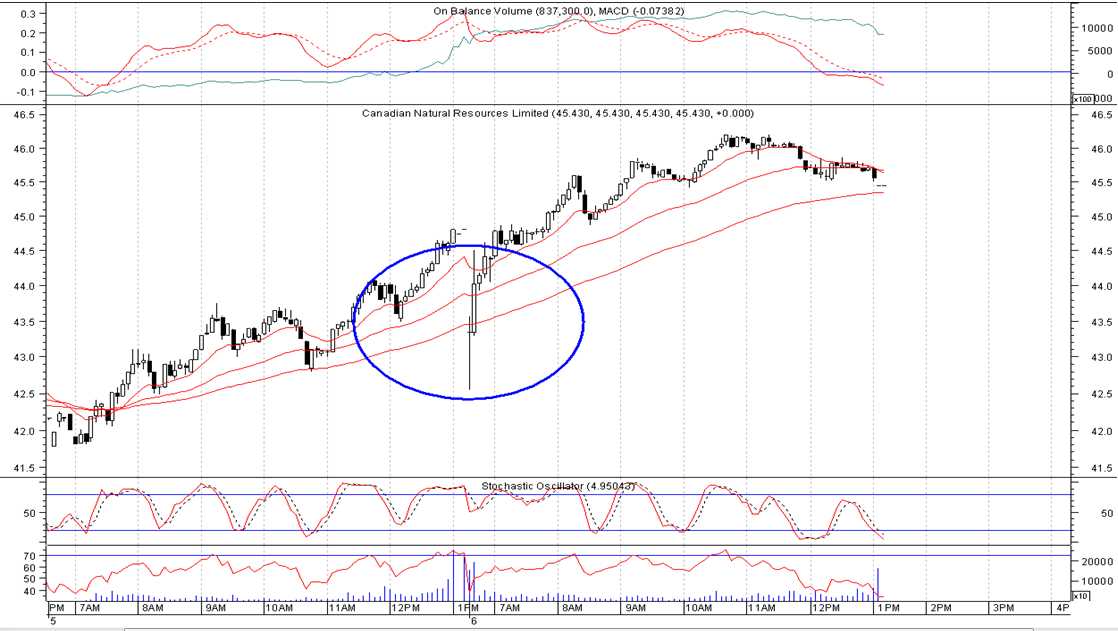
As an example (refer to the 5-minute Candlesticks charts below), let’s look at the trading of Canadian Natural Resources (CNQ), a reasonably liquid Canadian producer of over 565,000 barrels of oil equivalent per day, with a $30 billion enterprise value. So, USO starts rolling over their contracts early on February 6, before stock markets open. CNQ had closed the prior day, February 5, at CAD$44.81. On the open February 6 CNQ is down sharply at $43.35, and bottoms at $42.55 within the first 5 minutes of trading, and within 15 minutes after the opening was back up to $44.62. It closed the day at $45.43.


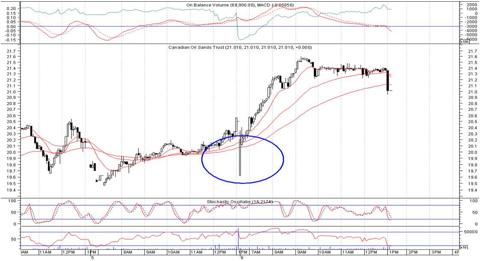
Canadian Oil Sands (COSWF.PK), another liquid stock that tracks the oil price, similarly started trading on February 6 down sharply at $19.62 after having closed at $20.50 on February 5. Within the first 15 minutes of trading it rebounded back up to $20.40. It closed the day up 51 cents at $21.01, with a high of $21.60.


These gap-down-opens were undoubtedly caused by nervous investors reacting to the sharp oil price drop reflected by the pre-opening futures markets (albeit in conjunction with horrible, but expected jobless numbers).

These ETFs are getting very popular, and are so large that they are having an increasingly large impact on the market. Reuters reports that USO has increased in size 400% just since early December.

This is an example of the crazy derivative trading that Warren Buffett warned us about years ago, and what brought down the world’s financial system last fall (think CDS – Credit Default Swaps).

But this is our current reality. Obviously, this trade is for sophisticated and/or brave and/or crazy investors. But if you are a good day trader, it could represent an opportunity for quick profits.

Friday, February 13, 2009

Today's trade on CL

Today, Front month crude rises about 11%, while most back month contracts have a moderate deline (2% for April and May). This is mainly due to contango trade covering before the long weekend prior to delivery week. If the short covering (March contract)is done, we should expect a moderate widening or no change of the contango into next week.


CL spread 03-05

CL spread 03-04


2-11-2009

Thursday, February 12, 2009

Tuesday, January 27, 2009

苏黎士投机定律

苏黎士投机定律

  苏黎士投机定律(Zurich Axiom)是早期在华尔街股市从事股票投机,并希望因此而致富的一群瑞士人所使用的术语。它包括一套实用且相关的定律,可提供任何投资者或投机者(投机和投资根本是一回事,因此以下投机和投资会交互使用),从事金钱游戏并控制风险的法则。

  这里要注意的是,它是陈述有关控制风险的方法,而不是要你.避免风险,因为任何投资都有风险,对吗?用这些定律检讨自己的得失并身体力行,你可能就会在今天大展鸿图。

定律1.如果你对自己从事的投机不感到忧虑,那么你冒的风险肯定不够。

  这句话是说,投资的资金一定要足,切勿听信专家所谓的“用闲置资金投资”的建议。当然问题在于多少钱才算足.但是我们不妨从反面来思考。如果你用所谓的闲钱十万元来投资股票,请问今年你可能赚多少?赚了一两倍又能增加自己多少财富?干脆直截了当的说,赌小钱绝对赚不到大钱,你以为如何?但这并非要你去大赌,而是要告诉你,投机的金额要大到让自己很在意或忧虑才行,而这就是合理或足够的投资金额。当然每个人所能承受的忧虑程度不同,因此投机的金额亦因人而异。

  这条定律也涵盖了两项次要原则,一是在你认为已经发掘了好投机机会时,尽量下足额的资金,二是切勿相信所谓的“不要把所有钱放在一个篮子”分散风险的建议,因为你不是大玩家。过份分散资金同样也分散获利的机会。

  总之,要学习下大赌注,不要怕赔钱,不要怕让自己心理受到创伤。事实上只要控制得当,最差的状况也不过是使自己再穷些而已。但相反地,获利的机会也将无可限量,或许甚至可以让自己脱难穷困。

定律2.尽早获利了结。

  这个定律要求你要节制自己的贪婪心理。在操作股票时,贪婪会表现在股价持续飘涨时的惜售,而原因是伯后悔。这也就是说,害怕在卖掉股票之后,股票会继续上涨。的确每个人都有这种经验,有时候它会令人懊恼得寝食难安。甚至会让有些人到了口中念念有词的地步。但是华尔街一直流行一句话是:“当股票卖掉之后,别再过问股价的涨跌。”

  华尔街老手的做法是,在进场买进股票一段时间,不管是赚还是赔,到了自己认为应该结束的时候就强迫自己结束,然后让自己好好轻松一番,完全不再过问股市。根据统计,这段轻松时间认一两周到一两个月后不等。

  至于游戏结束的时间如何决定呢?通常的作法是,事先决定自己希望达到的获利率,只要目标一达成就立即脱身。这条定律要告诉你的就是,要求自己在股价攀升到顶点之前脱手,不要期望命运之神会持续赐福予你。

  由于股票游戏并没有明订的起点或终点,一切都要靠自己决定,因此自己就是自己的裁判。当预定目标达成后,立即脱手,甚至退场后股价持续在攀升,也要压抑自己的贪念,不要被胜利冲昏头,又再进场。

定律3.当船开始下沉时,不要祷告,赶快脱身。

  换句话说,当股市走势趋于恶化时,就要立即脱身,甚至立即停损认赔,不要让自己套牢。在这方面投资人要克服的心理障碍,不只是除了怕股票卖掉之后的立即反弹,另外两大心理障碍是,不愿承受小额损失,以及始终盼望股市会反弹而死不承认自己眼光错误。事实上,买错或卖错是很普通的事,不足大惊小怪,只是要避免错得太离谱。

  欣然接受多次的小额损失,但是要设法候机扳回来。华尔街交易员曾经表示,金融操作赚赔的机会都是二分之一,只要能控制在赔小钱,而设法赚大钱,这才是赚钱赚在刀口上的道理。这个定律 告诫你,当事态转坏时,不要再心存侥幸心理,希望情况会好转。希望是心理创伤的治疗剂,但决不是从事投机活动的有效工具。任何从事股票投机的人最好接受停损做为必要的操作技巧。

定律4.人类行为是无法预测的,绝对不能相信任何能预测未来的未先知。

  分析师或股市名嘴经常到处谈论并预测股市走势和个股股价的涨跌,但是一般投资人很少会去检定这些预测的准确度。检验准确度最好的方法就是照着他们的话去做,看看成功的次数如何?获利性如何?当然谁也不能否认有些预测是准确的,但这也不能保证你一定能赚得到钱,是吗?

  不过这个定律要表达的是,不要相信任何人的预测,甚至不要以此做为自己从事股票投机操作的准绳。长远来说,这不会发生效用,金钱游戏纯属人类行为的范畴,根本无法预测。华尔街人士的建议是,价格涨跌变化的盘面永远是最正确的参考。不要根据任何对未来的预测的来决定投机行动的方针,最好是面对事实迅速地做出反应,决定行动的方向。

  因此,比较正确的心态是:“我有理由相信这样做会成功”,而不是“根据分析师的预测,我认为这样做一定会成功。”当事与愿违时,别忘了定律3棗立即停损。

定律5.混乱并不危险,相信规律才危险。

  简单的说,任何金融工具的走势绝对不存在所谓的规律、也没有可以绝对保证获利的公式可循。过份相信或依赖某种公式或诀窍,长远来看也不会有效。

  相信股市走势有规律存在的心理是假定了历史会重演。许多专家经常研究以往造成涨跌的原因,而后期待只要这些原因重复出现,大势也会因此涨跌。不过在你接受任何这类说法时不妨自问,为什么成千上万的聪明人,穷数十年之精力研究,却未因此而致富?或许这样就能让自己的脑筋清醒一点,不轻易相信这种说法。

  此外也别太相信技术分析。事实上技术分析也只不过是研究过去价格走势所形成的技术形态,如头肩顶、三角型,来决定买进卖出的操作技巧而已。事实上,你不妨照着做看看,试试准确性如何?其实成功的机会仍然是二分之一,各种走势形态事后看来或解释起来都头头是道。

  另外也不可轻信以下两说法:其一是认为股价走势必然是某些前因所造成,其二是认为自己运气来临了。总之,投机活动决无公式可循。在从事任何投机活动前,你都必须深思熟虑,只要自己确定这有潜力的机会,便慷慨下注。记住,投机决不可能在有规律的情况下进行,你一定会面临无数混乱的局面。只要自己保待清醒,就能避免受创过深。

定律6.不要让资金陷在某个投机工具上。随时得保持机动性。

  只要资金陷入某项投机工具上,机会成本就会很高,因为资金被卡死会让你失去投入其他获利更高的机会。一般经验显示,一个人越钟情于某项投机工具,就越不可能成为一个杰出的投机者。

  在这方面,任何人要克服的心理障碍是,不要因为个人的偏好,而将资金陷在已经没有希望的投机工具上。另一方面,只要发觉有吸引你的投机机会横在眼前,就要毫不犹豫的脱掉原来的樊笼。

  这个定律是希望你随时提高警觉,看看周遭的一切,不要因为自己的偏好而阻碍了其他的投机活动。所有的投机机会都要经过审慎的思考,切勿因为一些无谓的理由而阻碍了个人的行动。情势对自己不利时要勇于脱身,不要让自己陷得太深,无法全身而退。

定律7.只要是能够合理解释的直觉或预感,就可以作为投机活动的依据。

  这个定律相信直觉可能会是从事投机活动时有效的指导,决不可以因为它听起来有点愚蠢而等闲视之。当直觉或预感降临时,不妨自忖它从何而来?如果你的确在平常时间对某些投机工具曾寄予相当程度的关切或研究,甚至对它有某种程度的掌握时,就不妨相信自己的直觉。当然它也不会百分之百正确。

  但是要注意的是,不要把希望和直觉混为一谈。通常人在对某件事怀有相当程度的渴望时就会产生希望,而轻易相信这件事一定会发生。比较值得参考的辨别方法是,只要你认为自己渴望的事将会发生时,这种心理就应该以怀疑的态度看待。相反地,当直觉告诉你,事态的发展会和你希望的方面相反时,这种直觉往往很可靠.

  这是一个非常有趣的原理,它告诉你不要忽视直觉或预感在投机活动中所扮演的角色,而你必须以怀疑和谨慎的态度对待它。通常直觉都是从你个人以往经验所衍生而来的,只是你不知道它真正的来历。当强烈的直觉指引你时,只要能合理的加以解释,不妨相信它,试试看。

定律8.迷信股市的涨跌受超自然力支配,这是不可能的。

  这个定律要你别过份相信具有神秘色彩的预言。从78年开始、流行用紫微斗数判断股市走势,但是到底准确性如何,似乎也没有人在意。一般投资人在这方面所犯下的偏颇都是“宁可信其有,不可信其无”。其实,你自己做预测也不见得会很离谱。如果这些预言家的预言的确有效.那么他们早就发了。因此别对求神问卦的结果估计得太高。不过如果能淡然处之,你也可以从中享受一些乐趣。

  圣经上有句话说:“撒旦的归撤旦,上帝的归上帝。”最好还是把金钱世界和信仰世界分得清楚些,毕竟它不会带来太大的用处。有时候,当许多人都迷信某天股市行情会崩盘时,也确实是会有影响的,但仍不致会坏到无可收拾的残局。过份迷信的坏处是它会让你失去投机的警觉性,而在毫无提防的情况下让自己陷入绝境。投机最值得依赖的伙伴仍然是自己的智慧。

定律9.预期最佳状况会发生就是乐观,而信心则是知道如何处理最坏的状况。决不要因为乐观而采取投机活动。

  乐观的入经常受人赞美,但是在金钱世界里,过份乐观不会令你有所斩获。以78年的选举行情为例,利多与长红的极端乐观带来的是什么?当每个人都陷于极端乐观的情绪之中时,不妨做反向思考,或许反面才是对的。

  当每个人都很乐观时,自己也很容易因此而丧失独立的判断力。在从事投机活动时,不妨先思考好,当事态恶化时要如何处理?如果能找到答案,你就成了一个有信心的投机者。

定律10.不要跟着群众走,他们也会犯错。

  持这种态度的人经常会被指为过于自负。在金钱世界里,自负并不是一个人的缺点。不过当个人的看法和群众相异时,的确会为自己造成相当的压力。

  在自负方面有一个原则是可以确立的,亦即最佳的进场时机经常是当群众都不愿进场的时刻。回想78年台湾股市于11月14日的指数高峰l0499.58点跌到12月l1日的8176.08点,当时悲观气氛最浓烈的时候,是否就是最佳的进场时机.

定律11.失败时别气馁,设法忘掉失败的痛苦,重新再来。

  用俗话说就是要有毅力。从事投机活动决不可以心存一次成功的心理。华尔街许多杰出交易员早年都曾数度破产,但是他们却能不断的尝试、学习并且改变自己的个性,终于出类拔萃。

  但是毅力不可以和顽固混为一谈。典型的顽固是不承认自己投机所犯的错误,甚至设想要逢低承接,拉低平均成本。这种作法在情势转坏时会显得特别吃重,甚至会损失不赀。注意它和定律3的差别。

定律12.长期计划会让人产生未来完全在掌握之中的幻觉,决不要为自己做长期计划。

  事实上,你真正需要的长期计划应该以钱本身做为关切的焦点。也就是要致富的意愿。要尽量避免从事长期投资,只要有好机会就大胆投入,事态转坏就立即抽身。人要随时保持致富的高度企图心。

  如何致富是无法事先了解或计划的,你需要知道的事只是,总之有一天你会发财。套一句英国经济学家凯因斯的话说:“长期我们都死了

Saturday, January 24, 2009

1929-1932 the Dow crash


Contango

http://thefountainhead.typepad.com/contango/2007/01/contango.html

In Hilary's own words:

When a commodity futures contract is in backwardation, an investor has two potential sources of returns. Since backwardation typically indicates scarcity, one is on the correct side of a potential price spike in the commodity by being long at that time. The other source of return involves a bit more explanation. In a backwardated futures market, a futures contract converges (or rolls up) to the spot price. This is the “roll yield” that a futures investor captures. The spot price can stay constant, but an investor will still earn returns from buying discounted futures contracts, which continuously roll up to the constant spot price. A bond investor might liken this situation to one of earning “positive carry.” In a contango market, the reverse occurs: an investor continuously locks in losses from futures contracts converging to a lower spot price. Correspondingly, a bond investor might liken this scenario to one of earning “negative carry.”

In other words, for a backwardation (contango) commodity we buy (sell) a future contract further into the delivery curve and wait for its appreciation (depreciation) as it approaches the higher (lower) spot price.

Friday, January 23, 2009

USO and contango

"The US Oil Fund (Ticker: USO) holds long positions in West Texas Intermediate crude oil futures contracts, and rolls these contracts forward each month. Like most futures traders, USO buys futures with leverage, putting up a small portion of the money to buy the contracts. The rest of the money is invested in Treasuries, which generates interest income for the fund.

Three factors play a role in determining the performance of USO: 1) changes in the spot price of crude oil, 2) interest income on un-invested cash, and 3) the 'roll yield'. The first two factors are easily understood, but the third factor, 'roll yield' should be examined further in order to determine the extent, if any, to which traders of USO will be surprised by its performance in relation to spot crude oil.

First some background: Oil futures are available for each month of the year, so you can buy a futures contract right now which gives you the right to buy oil in February 2009, March 2009, April 2009, and so on. Currently, the price of oil in February 2009 is less than the price of oil in April 2009, a condition which is referred to as 'contango'. (If the opposite were true, the market for crude oil would be in backwardation.) Most commodity funds, including the US Oil Fund (USO) buy what is called the 'near month' contract and, because they do not want to take physical delivery of the commodity, they sell the current month's contract before it expires and buy into next month's contract. This process is called 'rolling forward', and it can result in the ETF paying up if the forward month contract is higher than the current month (contango), or cashing out if the opposition condition exists (backwardation).

To investigate the issue, I read through the 'risk factors' section of the USO prospectus. The following is relevant:

in the event of a crude oil futures market where near month contracts trade at a lower price than next month contracts, a situation described as ‘‘contango’’ in the futures market, then absent the impact of the overall movement in crude oil prices the value of the benchmark contract would tend to decline as it approaches expiration. As a result the total return of the Benchmark Oil Futures Contract would tend to track lower. When compared to total return of other price indices, such as the spot price of crude oil, the impact of backwardation and contango may lead the total return of USOF’s NAV to vary significantly. In the event of a prolonged period of contango, and absent the impact of rising or falling oil prices, this could have a significant negative impact on USOF’s NAV and total return.

In essence, the USO prospectus is warning traders that USO may experience a negative 'roll yield' which may cause the NAV of USO to deviate significantly from the spot price of crude. Is there historical precedence for USO deviating from spot oil by a material amount? As it turns out, the answer is 'yes'.

During the past two years, including 2006, these markets have experienced contango. This has impacted the total return on an investment in USOF units during the past year relative to a hypothetical direct investment in crude oil. For example an investment made in USOF units on April 10 and held to December 31, 2006 decreased, based upon the changes in the closing market prices for USOF units on those days, by 23.03%, while the spot price of crude oil for immediate delivery during the same period decreased 11.18%
The conclusion, at this stage of analysis, is that USO is not a direct play on the spot price of crude oil - it is, instead, a play on the spot price, forward prices, and the relationship between spot and forward (the slop of the futures curve).

For a trader who is long USO, my instinct is that maintenance or aggravation of the contango in crude oil will cause impairment of the value of USO in relation to spot crude - whereas, any mitigation of the contango situation (including a shift to a flatter curve or backwardation) will enhance the performance of USO.

I plan to study this issue more extensively. But, in the mean time, I will not consider USO to be a good proxy for the spot price of crude oil - and I will be particularly leery of participating in USO for anything other than a short term trade."

Thursday, January 15, 2009

Unhappy With Your Roth? Just Say Never Mind

Sponsored by 
by Walter Updegrave
Thursday, January 15, 2009
provided by

Ever made a financial decision you wish you hadn't, like buying a mutual fund that turned out to be a dog? Wouldn't it be neat if you could simply act as if it had never happened? Well, you have that choice when you convert a 401(k) or traditional IRA to a Roth IRA. That's right: Change your mind and you may be able to get a do-over.

The technical name for this second chance is a recharacterization, and basically it allows you to undo a conversion and transfer the balance (including earnings, if any) from your Roth IRA back to a traditional IRA. You can then leave it there or convert to a Roth IRA again later.

This sort of flexibility is always nice to have, but it can come in especially handy in three circumstances that you may find yourself facing today.

More from CNNMoney.com: 

• Danger: High Levels of Company Stock 

• Retirement Resolutions 

• Do You Want to Be Your Own Banker?

You converted, only to see the stock market tank. Let's say you switched a $150,000 IRA to a Roth IRA in 2008 but the collapse in stock prices has since knocked the Roth's value down to $100,000. Because the tax is based on the IRA's value at the time of the conversion, you're facing a tax bill of $42,000 this April (assuming a 28% tax bracket).

By recharacterizing, you can shift the $100,000 back to a traditional IRA. If your IRA is still worth $100,000 when you convert again, you'll owe $28,000 in taxes, saving yourself a tidy 14 grand.

You want to conserve your cash. In general, a switch to a Roth is more likely to pay off if you can cover the conversion tax with outside funds rather than by tapping the balance of the 401(k) or IRA itself. That may not be a problem in flush years. But when the markets are sinking and the economy is flailing, you may prefer to keep your taxable investment accounts and cash reserves intact for an emergency.

So if you've already converted but are now having second thoughts about depleting your savings, undo it and hold on to the money that would have gone to the IRS.

You're not sure the conversion is still tax-smart. Tax rates are always a major consideration in weighing a conversion (by paying taxes on your IRA balance today rather than in retirement, you're betting that your tax rate will be higher later). And with a new President who campaigned on a sweeping revamping of tax laws, we could see changes that may lead you to rethink your decision.

During his campaign, Obama said he would eliminate taxes for seniors making less than $50,000 a year. It's anyone's guess whether this will make its way into law. But if you're nearing retirement, it raises the possibility that converting to a Roth IRA could be a bad deal since you would pay taxes on IRA dollars you might be able to withdraw tax-free later.

The Rules of Recharacterization

To avail yourself of this mulligan, you have to obey some tricky tax rules. You can recharacterize a conversion anytime up to the income tax filing deadline for the tax year of your conversion, including extensions. So if you converted in 2008, you can undo it as late as Oct. 15, 2009.

If you want to roll your account into a Roth again, you must wait at least until the year after your original conversion (2009 or later if you converted in 2008), and your second conversion must be at least 31 days after your recharacterization. And, of course, you must still meet the Roth conversion eligibility rules: Your modified adjusted gross income, whether you're single or married, can't exceed $100,000. (This hurdle disappears in 2010.)

Finally, keep in mind that just because you have the right to a do-over doesn't mean you'll come out ahead by exercising it. If, for example, you recharacterize a Roth that's now worth $100,000 to save taxes, it's possible that stock prices could recover before you're able to switch back into a Roth, leaving you with a higher tax bill.

All things considered, though, it's comforting to know that you have an escape hatch available if you need it.

http://finance.yahoo.com/focus-retirement/article/106440/Unhappy-With-Your-Roth-Just-Say-Never-Mind;_ylt=AiGKnDTyjlsvsw33444pSy27YWsA?mod=retirement-IRA


Tuesday, December 30, 2008

Advantages Abound When Converting to Roth IRA

Sponsored by 
by Kelly Greene
Tuesday, December 30, 2008
provided by

I want to convert my IRAs to Roth IRAs in 2009. We are retired and don't make over $100,000 a year. Could you please give me the parameters for doing a conversion? Can you spread the taxes over two years?

—John and Deborah Sellers, Hoover, Ala.

Moving assets from a traditional individual retirement account to a Roth IRA is a way to take advantage of the stock market's dive.

You do have to pay income taxes upfront on the account's value when you roll over traditional IRA assets to a Roth. But most IRA owners have seen their account balances tumble due to the liquidity crisis. And income-tax rates are relatively low at the moment as well, says Ed Slott, an IRA consultant in Rockville Centre, N.Y. So, that income-tax bill could turn out to be a relative bargain.

More from WSJ.com: 

• Some Breathing Room for IRAs 

• Annuity Addresses Longevity Issue 

• Financial Pressure Is a Family-Room Topic

Other advantages: With a Roth, there are generally no taxes on withdrawals or future earnings, unlike with traditional IRAs. There also is no mandatory distribution schedule -- again in contrast with traditional IRAs, from which account holders must begin taking minimum distributions by April 1 of the year following the year they turn 70½ years old (though not in 2009 -- more on that below). And if you're hoping to leave an inheritance, it is more advantageous for your heirs to receive a Roth than a traditional IRA, because they would never have to pay tax on Roth withdrawals.

Legislation approved by Congress earlier this month suspends retirement-account distribution requirements for 2009. That means you could roll over assets from a traditional IRA to a Roth next year without first having to take a mandatory distribution, Mr. Slott says. In other words, the taxes you pay on your IRA assets' presumably beaten-down value would all be helping you get those savings into a Roth.

And if your assets fell in value after doing the conversion, you could "recharacterize" the account as a traditional IRA so you wouldn't have to pay income tax on value that no longer exists. You would have until Oct. 15, 2010, to recharacterize a Roth you converted at any point in 2009.

As you note, to be eligible to convert traditional IRA assets to a Roth, your modified adjusted gross income must be no more than $100,000 a year, either for an individual or a married couple filing jointly. Your mandatory IRA distribution (in years other than 2009) wouldn't count against that limit, and neither would the assets you convert to a Roth. But those amounts still count as taxable income, Mr. Slott says. (You can figure out your modified adjusted gross income using a work sheet in Publication 590 at irs.gov.)

Starting in 2010 -- not next year -- there are no income limits for Roth conversions. And for any conversions done in 2010, you can spread any resulting taxes across 2011 and 2012. The big wild card: Tax rates may increase in the next few years. "Paying the tax now removes the uncertainty of what future tax rates might be," Mr. Slott says.

Wednesday, December 10, 2008

Exclamation Eminis Rollover Days

Quick Facts about Rollover Day
(http://www.sentiment-traders.com/showthread.php?t=187)

The following applies to many (if not most) futures contracts especially those from the Chicago Mercantile Exchange (CME) and Chicago Board of Trade (CBOT).
  • Rollover is 8 days before expiration.
  • Expiration is the third Friday of each quarter month (March, June, September, December)
  • The contract letter associated with each month is: March=H June=M September=U December=Z
  • Rollover is on a Thursday.
  • Rollover is usually on the second Thursday of the month but will be on the first Thursday if the first day of the month falls on a Friday
  • Volume shifts to the new contract at market open (09:30 EST) on Rollover day
  • New day trading or swing trading positions opened on rollover day should use the new contract month irrespective of when you plan to close it.
  • New swing positions might be better opened using the new contract if opened within a few days of rollover day.
  • Market myths abound at rollover and expiration. Check the source and confirm the probabilities before believing anything.
Introduction to rollover days:
http://www.deltat1.com/Education/art...r/rollover.htm