Saturday, November 05, 2011

Spx TLs


ES daily


If ES trade/open above 1258, Bull will carry it to 1272/PreHi.
If Bull cannot hold on 1227-34 area, Bear will push it to PreLow/1190

Friday, November 04, 2011

Wednesday, November 02, 2011

Tuesday, November 01, 2011

ES daily 110111


Lessons

1. Never enter market on Sunday night; Gap down or up on Monday has the least possibility to fill.
2.

Sunday, October 30, 2011

spx weekly

Bull is back and will remain for a while!

Daily spx

Sentiment: bullish
Important  Fib level to watch
SP: 1257/1248
RS: 1293/1301

Tuesday, October 25, 2011

Monday, October 24, 2011

Saturday, October 22, 2011

Monday, October 17, 2011

History of Nine-Day Market Ramp-Ups Is Encouraging. Mostly.

http://blogs.wsj.com/marketbeat/2011/10/17/history-of-nine-day-market-ramp-ups-is-encouraging-mostly/


Birinyi
Table of 9-day ramps since 1950. Click for giant image.
Before today’s stumble, the S&P 500 had soared 11.4% in the prior nine trading days, a fairly rare event that typically sets up a much better market in the months ahead — with some notable exceptions.
The analysts at Birinyi Research, a bullish bunch, sent over a — wait for it — bullish table of how the market has performed after past nine-day ramps of 10% or more.
There have been 15 similar moves since 1950, according to Birinyi. The market has been higher six months after 11 of those moves, with an average gain of nearly 10%.
The four exceptions to this track record are cautionary, though. All four have happened since March 2000. The sample size is too small to draw any conclusions, but the positive implications of a 9-day ramp have been hit or miss since the turn of the century.
One of the 9-day ramps in this century was a 12.2% jump in November 2008, which was followed shortly by a brutal selloff that took the market to fresh lows.

Saturday, October 15, 2011

Sunday, September 25, 2011

Wednesday, September 21, 2011

iPath S&P 500 VIX Short-Term Futures ETN: Swimming Against the Currents

http://seekingalpha.com/article/267950-ipath-s-p-500-vix-short-term-futures-etn-swimming-against-the-currents


The VIX volatility index has made headlines in recent weeks by remaining at relatively low levels despite the great many potential catalysts for market upheaval. Many contrarian-minded speculators have been enticed into going long volatility -- and an increasingly popular way to accomplish this is with the VXX.

What investors in VXX must know is that the odds of profiting are not all that different from a video poker machine and the ETN administrators have about as much to gain from this as a Las Vegas casino.
Background
First, a quick primer on the VXX. VXX is an iPath ETN designed to mimic a 30 day futures contract on the VIX spot index (note: the VIX "spot" index is not directly tradable, so short term futures are the nearest proxy). The fund managers accomplish this by maintaining a balance of front-month (the next futures expiry date) and second-month contracts that keep the VXX always about 30 days out on the curve. As an example, on T=1, the first day after contract expiry (e.g., May 18), the VXX "holds" only contracts for the next expiry (June contracts). By T=15, the VXX consists of 50% June contracts and 50% July contracts, thus maintaining the 30 days away from expiry structure. Therefore, each day the VXX "sells" 1/30th of its assets in front month contracts and rolls them into second month contracts.
Pretty clever. However, there's a big catch. When the VIX futures curve is upward sloping, meaning people expect volatility to be greater in 2 months than in 1 month and so forth, there's an ongoing premium that must be paid to continually sell front month contracts and replace them with second month contracts (which, themselves, become front month contracts in a few weeks' time). This situation of more distant futures costing more than near-term ones is referred to as contango and the buy-high-sell-low situation it creates is called roll yield. VXX mirrors exactly this strategy, as is clearly laid out in the prospectus.
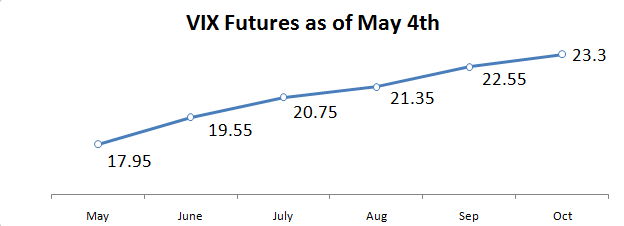
Recent impact as of this writing, the VIX futures curve looks as shown below. All else being equal (i.e, no shifting of the curve), if you buy a June settlement contract today and hold it for a month, you can expect that it'll trade at a price similar to what the May contract is at today. In other words you'd buy at 19.55 and in a month it would be worth 17.95, a roll yield of about 8%, which is analogous to paying an 8% monthlypremium to maintain a front month portfolio.
VIX Futures Curve
(Click to enlarge)
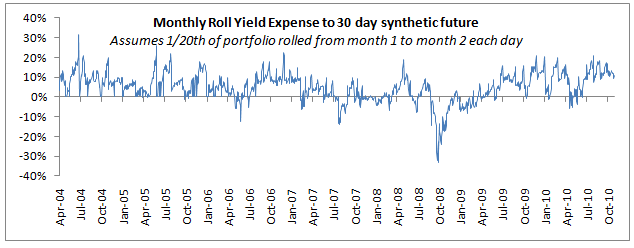
One interpretation is that the market is simply anticipating a rise in volatility in the next couple of months. However, here's the wrinkle: the VIX futures curve has been upward sloping (in contango) for the front two months about 75% of the time. The below chart shows the monthlyroll yield impact for the front month to second month from 2004 to 2010. Note, the below data was manually assembled from multiple source files on the CBOE website and may contain some errors.
Historical Roll Yield
(Click to enlarge)
Of course, paying a 5% or 10% or 15% monthly roll yield is a huge headwind for the VXX, and not surprisingly it has lost almost 95% of its value since its launch just 25 months ago. With the logarithmic Y axis, the constant decay nature of the VXX is strikingly apparent.
25 month VXX prices
(Click to enlarge)
A Theory…
So, the empirical evidence isn't favoring investment in the VXX, but perhaps longs are "not wrong, just early" as the saying goes? Is the market simply anticipating an increase in spot volatility that will eventually vindicate the VXX holders and cause a regime change from contango to backwardation?
Don't bet on it. According to Yahoo Finance as of this writing, VXX has assets of about $1.44B, suggesting exposure of somewhere between 0 and 1.44B in front month futures and the remainder in second month contracts. Assuming 21 trading days in a month, this implies that somewhere around $68M of month 1 contracts must be rolled into month 2 contracts every day. Based on the past couple weeks of market data, the May and June contracts (current M1 and M2) are trading around $200M to $300M per day, implying that the VXX daily rolling is already becoming 20-30% of the futures market volume, a huge number.
Since the buying and selling of transactions are always in the direction of steepening the futures curve (selling M1 contracts pushing down the futures price of M1, buying M2 contracts, lifting the futures price of M2) the VXX itself may become a structural reason for the very contango that is destroying shareholder value.
It's important to note, however, that VXX is an ETN, which differs in an important way from an ETF. While an ETF claims to hold a portfolio of the actual assets on which the fund is priced, an ETN is a simple promise to pay out based on a certain formula applied to traded instruments.
Thus, it's quite possible that Barclay's/iPath does not hedge their risk exposure, or hedges only partially. In an inquiry to their Investor Relations department, iPath provided the following disclosure:
Since iPath ETNs are unsecured debt instruments issued by Barclays Bank PLC, there are no assets to secure these products. The iPath ETNs simply pledge the returns of the index less the investor fees. For these reasons, the information on how the assets are invested is not disclosed.
Given the structural flaws of VXX, I wouldn't blame iPath if they chose not to hedge, and instead chose to effectively remain short the instrument they created. If that's the case (and I have no way of knowing), I would find it unsettling to have my interests in direct opposition to the creators of it. It would be like investing with a fund that received a performance bonus on losses.
If I were long VXX, I'm not sure which would be more unsettling: knowing that the fund's hedging was moving the markets into contango or the that the instrument's sponsor was betting on its continued decline. Since the VXX continues to gain in popularity and size, I suspect that whatever is happening will not relent.
The Trade
This is the easy part. Stay away from the VXX, or if you have the stomach, short it. The trick, of course, is that volatility can be volatile. Being too aggressive with shorting a contract that can spike so abruptly is a bad idea, no matter how favorable the odds. Prudent risk management practices of limiting the position to a small fraction of your portfolio and setting a worst case stop loss (either real or mental) can keep the downside manageable.

Monday, September 12, 2011

Inverse Vix ETN

http://etfdb.com/2011/inverse-vix-etns-reviewing-all-the-options/


Inverse VIX ETNs: Reviewing All The Options

by MICHAEL JOHNSTON on JUNE 23, 2011 | ETFs Mentioned:  •  •  •  •  • 
As the lineup of ETFs approaches the 1,300 mark, a growing pool of issuers continue to deliver innovative new products that tap into strategies and asset classes that have never before been accessible through the exchange-traded structure. One relatively new area that has attracted billions of dollars in new assets in recent years is the volatility space; there are now 15 ETPs in the Volatility ETFdb Category with aggregate assets of nearly $3 billion.
The development of volatility ETPs has been an interesting illustration of the increasingly wide reach of the ETF industry. Unlike stocks and bonds, a direct investment in volatility isn’t possible; the relevant values are derived from prices of other securities, and it isn’t possible to simply go out and buy volatility. Because volatility tends to move in the opposite direction of equity markets, the idea of transforming this metric into an investable asset had obvious appeal to investors looking to bet on a spike in anxiety or to use as an efficient hedging tool in connection with more advanced short-term strategies [see Reviewing All The VIX ETF Options].
The development of futures and options linked to volatility contracts made such an investment possible–at least for those with the ability to trade and monitor positions in derivatives. The packaging of those securities within the exchange-traded wrapper wasn’t far behind, and that innovation made establishing exposure to volatility as easy as buying shares of GOOG or MSFT.

Appeal Of Inverse VIX

The first VIX ETNs offered long only exposure to an index comprised of futures contracts, and these products quickly became popular among short-term traders as instruments for hedging equity positions or speculating on short term swings in stocks. It didn’t take long for anyone using the VIX products over a longer time period to get a feel for the impact of the futures-based strategy on bottom line returns.
VIX futures markets are often in a state of contango, meaning that long-dated futures are more expensive than those closer to expiration. At the short end of the maturity curve, that contango can be quite steep. That means that the “roll yield” incurred when selling expiring contracts to buy up next-to-expiration futures can be hefty, creating a significant gap between a futures-based VIX ETP and the hypothetical return on a spot investment in the VIX (which isn’t possible).
Last year the iPath S&P 500 VIX Short-Term Futures ETN (VXX) lost more than 72% of its value, a massive decline compared to the more modest 18% dip in the spot VIX.
More recently, a number of ETNs have debuted that effectively give investors a tool to exploit the structural inefficiencies in VIX futures markets that accounted for that huge discrepancy. These inverse VIX ETPs essentially allow investors to play the role of the insurance company, selling portfolio insurance with a relatively high premium. If the big one hits–like it did in 2008–these products are likely to get pummeled by a surge in volatility. But if measures of volatility hold steady or even rise modestly, the wind at the back of these products gives investors a potentially compelling return enhancement mechanism [Inverse VIX ETNs: Free Money?].

Inverse VIX ETNs

Those looking to establish inverse exposure to the VIX and profit from the same contango that cripples long-only funds over the long run have a number of options to choose from. And while there are some general similarities, many of these inverse VIX ETNs are quite different from one another [sign up for the free ETFdb newsletter]:

VelocityShares Daily Inverse VIX Short-Term ETN (XIV)

This ETN is perhaps the most efficient tool available for those looking to profit from the steep contango in VIX futures markets. XIV seeks to deliver daily results that correspond to the inverse of an index made up of short-term futures contracts. That focus means that XIV is often hammered when volatility spikes, but should perform well during periods of falling or even flat volatility. Because XIV seeks to deliver the inverse of a futures-based index, it isn’t uncommon for this product to rack up gains during periods in which the spot VIX actually climbs.
It’s important to note that XIV resets exposure on a daily basis; that frequency can have a significant impact on the risk/return profile of this fund. Investors with a holding period of longer or shorter than a day may experience returns that vary from the target -1x multiple, and the compounding of returns can work either for or against investors.
Since its launch in November of last year XIV has gained nearly 70%, making it one of the top ETP performers over that stretch. The spot VIX has declined by about 15% during that same stretch, illustrating the potentially powerful benefits to shorting a strategy facing stiff headwinds in the form of consistent contango [Five ETF Strategies For A Sideways Market].

VelocityShares Daily Inverse VIX Mid-Term ETN (ZIV)

This ETN also offers inverse exposure to an index comprised of VIX futures, but focuses on a benchmark comprised of securities with a longer time until maturity. The related index has a constant weighted average maturity of five months, which reduces both the volatility and the impact that the slope of the futures curve has on calculated returns. So ZIV will generally experience both single day and multi-period price swings that exhibit near perfect correlation to XIV, but with less volatility. For investors looking to tap into the inverse VIX investment thesis with less substantial risk in the event of a stock market collapse, ZIV can be a useful tool [Talking VIX And Volatility ETPs With Nick Cherney].

iPath Inverse January 2021 S&P 500 VIX Short-Term Futures ETN (IVO)

This ETN also offers inverse exposure to an index comprised of short-term VIX futures, as IVO and XIV are linked to the same benchmark. But this iPath ETN strives to achieve this objective over the term of the note (as opposed to over the course of a single trading session). Launched in early 2011, IVO matures ten years later; that period represents the period over which IVO will deliver inverse exposure [see Reviewing Three Types Of Leveraged ETFs].
So as the underlying index moves, the effective exposure offered varies as well. Just as products like XIV and ZIV will only achieve their target multiple over the course of a single trading day, IVO will only achieve its target objective over the course of the note. Those getting into this product somewhere along the line are likely to achieve results that vary considerably from the target multiple of -1.0. Currently, the participation value for IVO  is 0.62, indicating that a position established now will only experience a fraction of the inverse movement in the underlying index between now and maturity.

iPath Barclays ETN+ Inverse S&P 500 VIX Short-Term Futures ETN (XXV)

XXV debuted in July 2010, and the notes mature in July 2020. Since this ETN launched the underlying index has plummeted, thanks in no small part to persistent contango in VIX futures markets. The steep decline has had a couple of effects on XXV; this ETN has performed quite well, gaining close to 75% over the last year. That run-up has also diminished the participation ratio significantly, meaning that investors buying in now won’t experience long-term returns that correspond to -100% of the underlying index.
Recently XIV’s participation ratio was just 0.13, indicating that the movement in this ETNs price shouldn’t be expected to come close to the inverse of changes in the related index. While the performance of the note over the life of the obligation will meet that objective, the steep run-up in value (XXV has gained more than 70% since inception last July) has diminished the sensitivity to further movements in the index.

E-TRACS Daily Long-Short VIX ETN (XVIX)

This ETN from UBS is unique in that the underlying index includes both long and short exposure to VIX–specifically a 100% long position in mid-term VIX futures and a 50% short position in short-term VIX futures contracts. The short position positions XVIX to benefit from the structural inefficiencies in the VIX futures markets, while the long position allows for exposure to volatility that may not be impacted as adversely by contango. XVIX rebalances exposure on a daily basis.
The methodology behind XVIX makes this product very unique from the others highlighted above in terms of risk/return profile. The combination of long and short exposure to similar asset classes results in a relatively low volatility–a feature the other inverse VIX ETNs do not share. XVIX might be useful for those looking to add non-correlated assets to their portfolio, as the movements in the underlying benchmark will generally exhibit very little correlation to stocks or bonds [Examining VIX ETF Performance During A Sell-Off].

Big Differences In Performance

The nuances highlighted above may seem subtle, but they can have a huge impact on performance. Through the end of last week XIV had gained about 30% year-to-date, more than quadrupling the gains turned in by another inverse VIX ETN (XXV was up about 7%).
Each of these products has the potential to be a very useful tool or a wildly inappropriate mechanism; that all depends on the risk tolerance and objectives of the individual investor [Using ETFs To Access Alternatives].