Showing posts with label uso. Show all posts

Friday, April 24, 2009

Monday, April 13, 2009


Note:
USO: US Oil Fund (Ticker: USO) holds long positions in West Texas Intermediate crude oil futures contracts, and rolls these contracts forward each month.

OIL: the IPath crude Oil ETN (exchange traded note),similar to USO which involves negative roll yields in a contango market,but also credit risk. With ETNs, you are an unsecured creditor of Barclays (the issuer of the note), so you have credit risk overlaid on the risk of the commodity.

DBO: Rather than select a new futures contract based on a predetermined schedule (e.g., monthly), each Index Commodity rolls to the futures contract which generates the best possible ‘implied roll yield.’ The futures contract with a delivery month within the next thirteen months which generates the best possible implied roll yield will be included in each Index. As a result, each Index Commodity is able to potentially maximize the roll benefits in backwardated markets and minimize the losses from rolling in contangoed markets.

Thursday, February 19, 2009

USO roll, CL contango and etc.


here is an interesting article about USO roll:

How to Trade Oil ETF Volatility

http://seekingalpha.com/article/119327-how-to-trade-oil-etf-volatility

Keith Schaefer and Richard Reinhard

Few investors realize it, but the oil ETFs give investors a monthly opportunity to make day trading profits on senior oil stocks.


The United States Oil Fund (USO) is now so large, it contains more than 20% of the outstanding March crude oil futures contracts (West Texas Intermediate, or WTI). Now, being an ETF, it does NOT want to take physical delivery of that oil. So at some point each month – and that would be the 5th, 6th and 7th business days of the month – it rolls over their entire set of contracts to the next month – putting undue, abnormal pressure on the oil price those days. The Goldman Sachs Commodity Index does the same thing every month, but on the 6th, 7th and 8th business days. Roll dates are usually published in advance – USO provides theirs on their website.

BetaPro Horizons, which operates the Canadian oil ETFs, symbols HOU and HOD, say they roll over their Light Sweet Crude Oil Futures contracts on the 7th, 8th and 9th business days, but claim their holdings are so small compared to the other two that there would be no impact in the markets from their activity. Still, it would likely accentuate the already abnormal pressure.

Trading for the WTI contract is open 01:00 London (local time). The close is at 23:00 London time, except Monday morning when the open is 23:00 London time. In other words, well before stock markets open for trading, investors can see what the futures are doing, and will often react to their direction.

Savvy investors can potentially benefit from this event by buying senior oil stocks, whose performance tends to mirror the oil price almost exactly, with timely at-the-market orders, just as other investors react to the pre-opening WTI futures contract price down-tick as “forced” selling by these ETFs takes place. They can either do this ahead of the anticipated price pressure by selling their stocks at the close the day before, and/or by buying these stocks during the spike-down opening trade. Really aggressive investors may take advantage using the underlying options on these stocks - a tougher trade requiring precision timing and loads of experience.

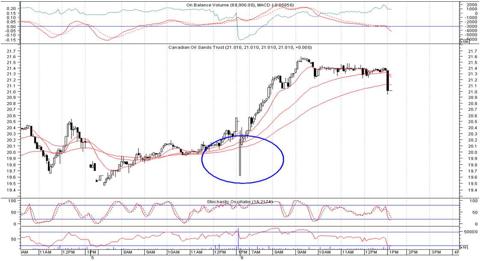
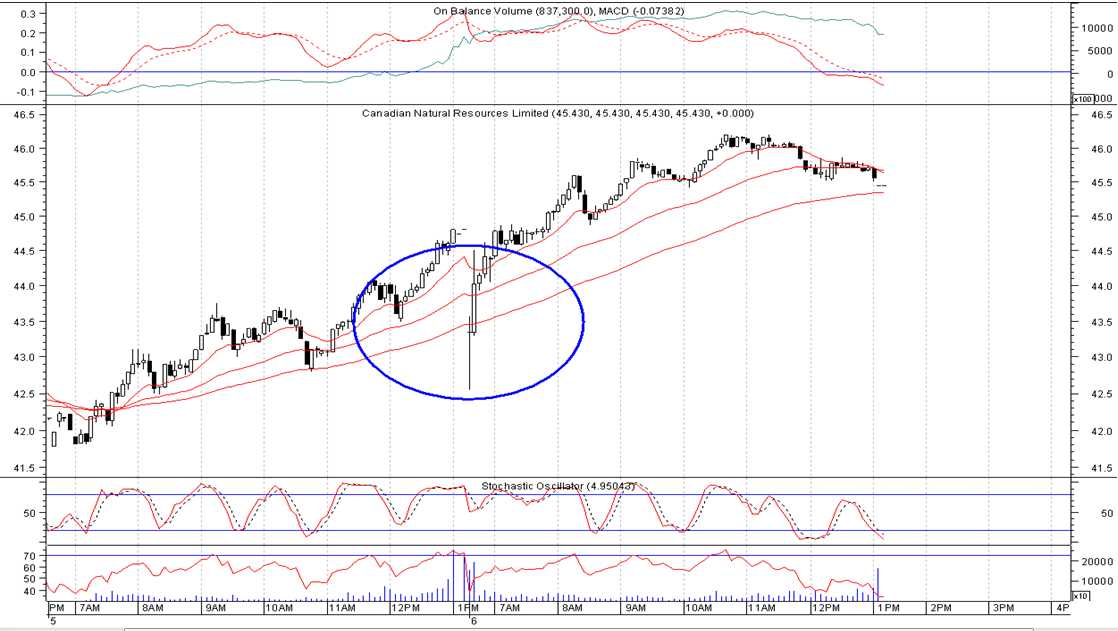
As an example (refer to the 5-minute Candlesticks charts below), let’s look at the trading of Canadian Natural Resources (CNQ), a reasonably liquid Canadian producer of over 565,000 barrels of oil equivalent per day, with a $30 billion enterprise value. So, USO starts rolling over their contracts early on February 6, before stock markets open. CNQ had closed the prior day, February 5, at CAD$44.81. On the open February 6 CNQ is down sharply at $43.35, and bottoms at $42.55 within the first 5 minutes of trading, and within 15 minutes after the opening was back up to $44.62. It closed the day at $45.43.


Canadian Oil Sands (COSWF.PK), another liquid stock that tracks the oil price, similarly started trading on February 6 down sharply at $19.62 after having closed at $20.50 on February 5. Within the first 15 minutes of trading it rebounded back up to $20.40. It closed the day up 51 cents at $21.01, with a high of $21.60.


These gap-down-opens were undoubtedly caused by nervous investors reacting to the sharp oil price drop reflected by the pre-opening futures markets (albeit in conjunction with horrible, but expected jobless numbers).

These ETFs are getting very popular, and are so large that they are having an increasingly large impact on the market. Reuters reports that USO has increased in size 400% just since early December.

This is an example of the crazy derivative trading that Warren Buffett warned us about years ago, and what brought down the world’s financial system last fall (think CDS – Credit Default Swaps).

But this is our current reality. Obviously, this trade is for sophisticated and/or brave and/or crazy investors. But if you are a good day trader, it could represent an opportunity for quick profits.

Friday, January 23, 2009

USO and contango

"The US Oil Fund (Ticker: USO) holds long positions in West Texas Intermediate crude oil futures contracts, and rolls these contracts forward each month. Like most futures traders, USO buys futures with leverage, putting up a small portion of the money to buy the contracts. The rest of the money is invested in Treasuries, which generates interest income for the fund.

Three factors play a role in determining the performance of USO: 1) changes in the spot price of crude oil, 2) interest income on un-invested cash, and 3) the 'roll yield'. The first two factors are easily understood, but the third factor, 'roll yield' should be examined further in order to determine the extent, if any, to which traders of USO will be surprised by its performance in relation to spot crude oil.

First some background: Oil futures are available for each month of the year, so you can buy a futures contract right now which gives you the right to buy oil in February 2009, March 2009, April 2009, and so on. Currently, the price of oil in February 2009 is less than the price of oil in April 2009, a condition which is referred to as 'contango'. (If the opposite were true, the market for crude oil would be in backwardation.) Most commodity funds, including the US Oil Fund (USO) buy what is called the 'near month' contract and, because they do not want to take physical delivery of the commodity, they sell the current month's contract before it expires and buy into next month's contract. This process is called 'rolling forward', and it can result in the ETF paying up if the forward month contract is higher than the current month (contango), or cashing out if the opposition condition exists (backwardation).

To investigate the issue, I read through the 'risk factors' section of the USO prospectus. The following is relevant:

in the event of a crude oil futures market where near month contracts trade at a lower price than next month contracts, a situation described as ‘‘contango’’ in the futures market, then absent the impact of the overall movement in crude oil prices the value of the benchmark contract would tend to decline as it approaches expiration. As a result the total return of the Benchmark Oil Futures Contract would tend to track lower. When compared to total return of other price indices, such as the spot price of crude oil, the impact of backwardation and contango may lead the total return of USOF’s NAV to vary significantly. In the event of a prolonged period of contango, and absent the impact of rising or falling oil prices, this could have a significant negative impact on USOF’s NAV and total return.

In essence, the USO prospectus is warning traders that USO may experience a negative 'roll yield' which may cause the NAV of USO to deviate significantly from the spot price of crude. Is there historical precedence for USO deviating from spot oil by a material amount? As it turns out, the answer is 'yes'.

During the past two years, including 2006, these markets have experienced contango. This has impacted the total return on an investment in USOF units during the past year relative to a hypothetical direct investment in crude oil. For example an investment made in USOF units on April 10 and held to December 31, 2006 decreased, based upon the changes in the closing market prices for USOF units on those days, by 23.03%, while the spot price of crude oil for immediate delivery during the same period decreased 11.18%
The conclusion, at this stage of analysis, is that USO is not a direct play on the spot price of crude oil - it is, instead, a play on the spot price, forward prices, and the relationship between spot and forward (the slop of the futures curve).

For a trader who is long USO, my instinct is that maintenance or aggravation of the contango in crude oil will cause impairment of the value of USO in relation to spot crude - whereas, any mitigation of the contango situation (including a shift to a flatter curve or backwardation) will enhance the performance of USO.

I plan to study this issue more extensively. But, in the mean time, I will not consider USO to be a good proxy for the spot price of crude oil - and I will be particularly leery of participating in USO for anything other than a short term trade."

Saturday, February 16, 2008

Thursday, January 10, 2008

Saturday, December 29, 2007